
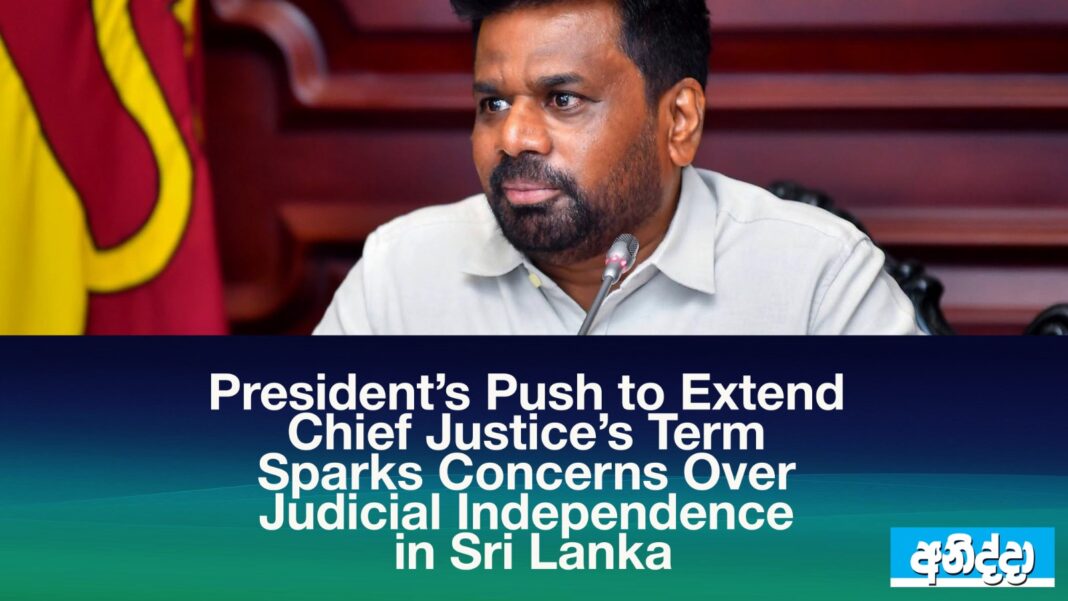

The Sri Lankan government is advancing plans to amend the Constitution to raise the retirement age of Supreme Court judges from 65 to 67 and Court of Appeal judges from 63 to 65. The move is widely seen as a deliberate effort to allow Chief Justice Preethi Padman Surasena — who is due to retire in December 2026 — to remain in office for an additional two years.
President Anura Kumara Dissanayake has repeatedly expressed his strong desire to retain Justice Surasena, citing the need for continuity in pursuing legal actions against alleged corrupt officials from previous regimes. The 22nd Constitutional Amendment is expected to facilitate this extension.
This serves both to bolster its popularity — as broader “system change” reforms have been slow — and to weaken the opposition.
Prosecutions and Political Strategy
The National People’s Power (NPP) government has pursued an aggressive campaign of investigations, arrests, and prosecutions targeting politicians and officials from earlier administrations. This serves both to bolster its popularity — as broader “system change” reforms have been slow — and to weaken the opposition.
Many high-profile cases originate in trial courts, proceed through the Court of Appeal, and can reach the Supreme Court on final appeal. Securing a trusted apex judiciary is therefore critical for the government’s strategy of minimising overturned convictions. Critics contend that the push to retain the current Chief Justice reflects a calculated attempt to shape judicial outcomes in politically significant matters.
The extension would also prevent the next senior judge, Justice Yasantha Kodagoda, from assuming the top post. Many legal observers view this personalised constitutional change as undue executive interference in the judiciary.
Disruption Across the Judicial Hierarchy
The government argues that longer tenures will allow experienced judges to serve longer in higher courts and provide better career progression for those awaiting promotion. In reality, raising the retirement age at the top levels is expected to stall promotions throughout the judiciary for at least two years.
Judges in the High Court and District Courts who anticipated elevation will remain in their current roles, potentially retiring without reaching the positions they legitimately expected. This has caused considerable dissatisfaction within the judicial service, where many professionals joined after private practice, endured difficult postings, and accepted modest salaries in anticipation of orderly advancement.
Recent cases highlight the issue: senior Court of Appeal judges have retired without elevation to the Supreme Court due to unfilled vacancies.
Limited Demand from Within the Judiciary
There has been little public or institutional demand for extending retirement ages. A notable example occurred when the Judicial Service Association (JSA) — the official representative body for Magistrates and District Court Judges, who form the backbone of Sri Lanka’s trial court system — met with President Dissanayake.
The JSA’s primary concerns during the meeting were judges’ salaries, working conditions, and other professional challenges faced by lower court judges, who often handle heavy caseloads in difficult environments across the country. The association did not request an extension of retirement ages for higher court judges. Reports indicate that the government raised the proposal during the meeting in an attempt to secure the JSA’s support, which later triggered internal controversy. The JSA’s executive committee subsequently clarified that the chairman’s stance on the matter was personal and not the official position of the association. A special general meeting has been convened to discuss the issue further.
International Comparisons and Broader Context
The government has cited longer life expectancies and international precedents. However, most nations, including India (where the Supreme Court retirement age remains 65), maintain fixed retirement ages to protect judicial independence. The United States’ lifetime appointments are an outlier tied to a distinct constitutional system involving Senate confirmation, not a straightforward model for Sri Lanka.
Parallels with Past Executive Overreach
This development echoes earlier episodes of judicial interference. In 2013, President Mahinda Rajapaksa removed Chief Justice Shirani Bandaranayake, whom he distrusted, and installed a more compliant successor. That action damaged the judiciary’s reputation for independence.
The current effort — extending the term of a favoured Chief Justice rather than removing an unfavoured one — represents the flip side of the same problem. Both tactics subordinate judicial tenure to presidential preference and undermine the separation of powers.
A Missed Chance for Genuine Reform
Sri Lanka would benefit from comprehensive judicial and constitutional reform, including a new constitution addressing appointments, tenure, and efficiency across the public service. The NPP campaigned on systemic change but has made limited progress on a new constitution, with the Prime Minister recently indicating it is not an immediate priority.
Rather than pursuing broad, transparent consultation on retirement policy, the government is advancing a narrow amendment seemingly tailored to one individual. Such tinkering risks eroding public trust in the judiciary’s independence.
As Sri Lanka navigates its democratic journey, the handling of this issue will be closely watched by both domestic observers and the international community. A judiciary perceived as independent is fundamental to the rule of law; extending one person’s tenure through constitutional change, without broader consensus, raises serious questions about the government’s commitment to institutional integrity.


